
Production Notes
Gil Is Awful
Internal documentation for the creative team. Story structure, character notes, and thematic framework.
Contents
Section 1
Logline
A senior engineer named Jan Eriksen walks us through fixing a production bug with impeccable professionalism, charming quirks, and hard-won expertise. The audience finds themselves nodding along, impressed. Then the screen glitches, and a different voice speaks: "Jan doesn't exist." The horror isn't that AI can code. The horror is that you couldn't tell the difference.
Genre: Corporate Training meets Psychological Thriller
Runtime: ~15 minutes (95 slides)
Audience: Engineering leaders, product teams, anyone skeptical of AI capabilities
Section 2
Tone Document
The Mood
Start warm. Professional. The kind of presentation you've seen a hundred times at tech conferences. The audience settles in. They trust it.
Then cold. The color temperature shifts. The voice changes. What felt like a helpful tutorial becomes something else entirely. Not threatening, but unsettling. The realization creeps in.
End empowering. The discomfort transforms into possibility. "You can do this too."
Primary Influences
Black Mirror: "Be Right Back" (S2E1)
A woman interacts with an AI trained on her deceased partner's messages. She can't tell the difference. That uncanny valley of "almost human."
Black Mirror: "Joan Is Awful" (S6E1)
A woman discovers her life is being auto-generated as streaming content. The horror of realizing nothing is original, nothing is private.
Ex Machina
The Turing test as narrative structure. The audience is the test subject. They don't know they're being evaluated.
The Usual Suspects
The retrospective reveal. Everything you watched means something different now. You want to rewatch immediately.
Visual Language
Act 1: Title
Glitch text, chromatic aberration, static noise. Netflix's Black Mirror intro energy. Sets unease, then forgotten.
Act 2: Jan's Tutorial
Clean, professional, warm amber tones. Standard tech presentation. The audience forgets Act 1 entirely.
Act 3: The Reveal
Screen tears, color shifts cold. Starker layouts, more negative space. The narrator's slides feel different.
Section 3
Character Brief: Jan Eriksen
Jan Eriksen
Senior Software Engineer, 15 years experience
Background
Started with C++ game engines, evolved through Java enterprise, Ruby startups, Go microservices, and now TypeScript/React. Has seen every architectural fad come and go.
Burned out at a hypergrowth startup where "move fast and break things" meant 3 AM pages and unmaintainable spaghetti. Took a year off, hiked the Pacific Crest Trail. Binged every Uncle Bob video during rest days. Somewhere around mile 1,200, the synthesis clicked: clean code principles are right, but dogma kills pragmatism.
Now maintains two open-source tools: complexity-guard (static analysis for cyclomatic complexity) and coverage-lens (test coverage visualization). These aren't about gatekeeping; they're about catching problems early.
Core Drives
- ■ Simplicity First: If a junior dev can't understand it in 5 minutes, it's too complex.
- ■ Pragmatic: Makes practical trade-offs. Perfect is the enemy of shipped.
- ■ Detail-Driven: Needs to know the code is well-written, not just believe it. Runs the metrics.
- ■ Refactor Under Green: Never refactors without tests. Red-green-refactor isn't just TDD; it's how you refactor safely.
The Quirks
These humanizing details make the twist land harder. The audience connects with them.
Writer's Note
"The more human he feels, the harder the reveal hits. Every quirk is a trap. The bonsai trees, the instant coffee, the Vangelis obsession, they make you forget you're watching something artificial. That's the point." — Emma, Dialogue Writer
Signature Lines
"Carry less, go further. Works for backpacks. Works for code."
"The best code is code you don't have to write."
"If I can't measure it, I can't trust it."
"Life's too short to optimize everything. I save my energy for code."
Section 4
Story Structure
Three-Act Breakdown
Introduce Jan. Establish competence, likability, quirks. Walk through a bug fix professionally. The audience nods along: "solid engineer," "good process," "I wish I had someone like this."
Jan finishes the fix. Says goodbye. The screen glitches. A different voice speaks. "Here's the thing about Jan..." The audience realizes something is wrong.
"Jan doesn't exist." Unpack what they just watched. Shift from horror to empowerment: "You can do this yourself." Credits reveal the entire production team was AI personas.
Beat Sheet
Meet Jan
Introduction, credentials, quirks. Establish the voice.
The Bug Arrives
"Date picker breaks in Safari." Vague ticket. First rule: reproduce it.
Confirm Tests Fail
Tests pass. That's bad news. Missing coverage. Write a failing test first.
The Investigation
Trace the code. Find the bug. "I've seen this before." (Has he though?)
TDD and Quality
Red to green. Check the gates. Jan notices missing pre-commit hook. Adds it without asking. Too efficient.
The PR
Clean. Professional. Reviewable in 5 minutes. "Job done."
THE REVEAL
Glitch. Voice change. "Jan doesn't exist." Unpack the deception.
How to Use This
Empowerment. "Create your own Jan." The power of AI personas.
Closing & Credits
"Coming to your workplace. 2027." Credits reveal AI production team. "...yet."
Section 5
Thematic Statement
The horror isn't that AI can code. The horror is that you couldn't tell the difference.
Core Themes
Identity & Authenticity
What makes expertise "real"? Jan has no lived experience, yet his process is impeccable. His quirks are fabricated, yet they made you like him. If the output is indistinguishable, does the source matter?
The Turing Test of Expertise
The audience is unknowingly taking a test. They're evaluating Jan as they would evaluate any engineer. He passes. They only realize they were being tested when the reveal happens. The presentation itself is an argument: if you can't tell, maybe you don't need to.
The Constructed Self
"No mechanical keyboards from 1989. No bonsai trees on the windowsill. No one drinking instant coffee to Blade Runner." These details felt so real because that's what makes anyone feel real. Personality is performance. Jan's performance was just more deliberate.
Empowerment Through Discomfort
The discomfort of the reveal transforms into possibility. The same tools that created Jan are available to everyone. The presentation doesn't just show what AI can do; it shows what you can do with AI.
Director's Note
"This isn't anti-AI doom. It's not techno-utopianism either. It's a mirror. Watch yourself watch Jan. Notice when you trusted him. Notice when you doubted. The presentation asks: what were you actually evaluating? And were you right?" — Charlie, Head Writer
Section 6
References
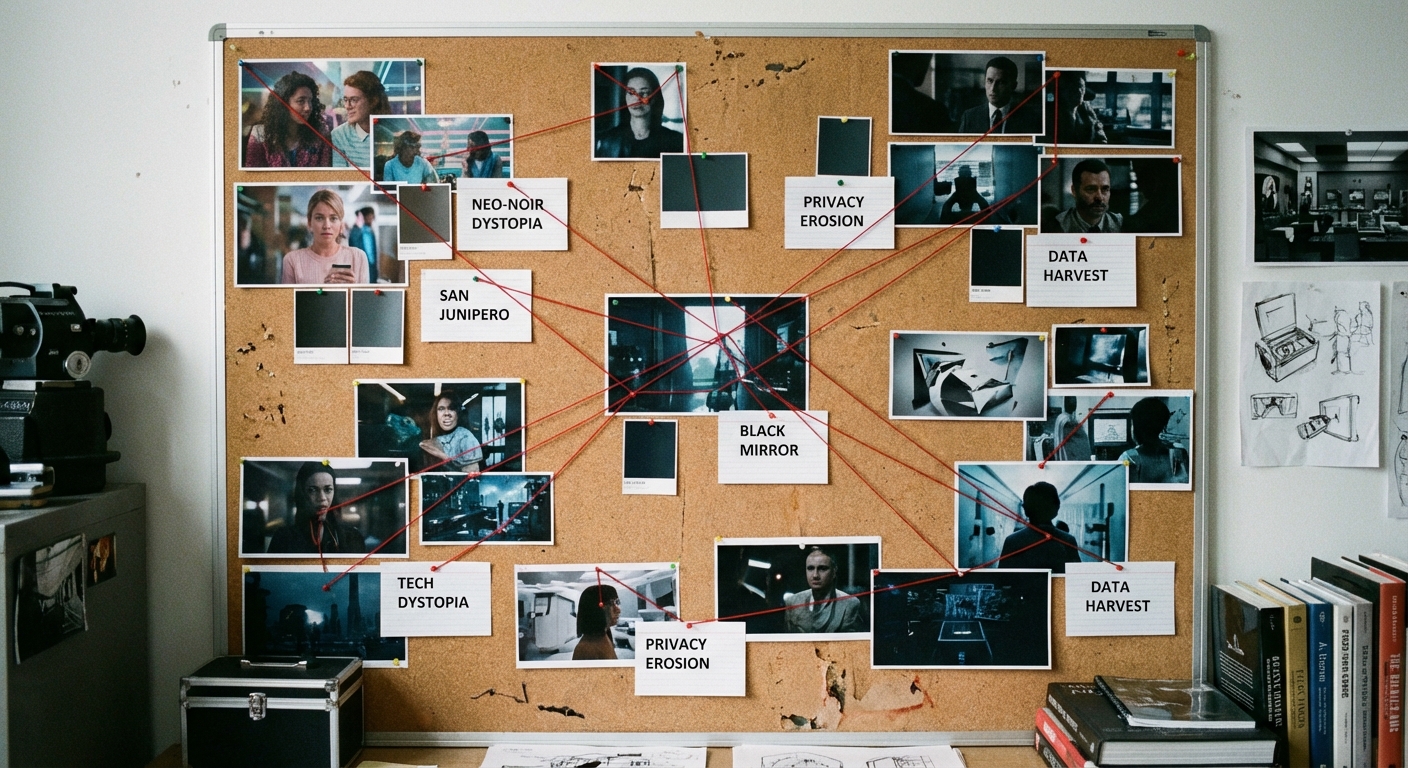
Production moodboard: Black Mirror aesthetics, tech noir, corporate horror
Title Reference
"Gil Is Awful" is a wink to:
- • Black Mirror vibes (technology that makes you uncomfortable)
- • "Everybody Hates Chris" (the sitcom)
- • The frustration of working with someone whose standards are higher than yours
Related Materials
- • Writers' Room Notes
- • Design System
- • How This Was Made
- • 06: Bug Fix Workflow (tutorial version)